Categories
Uncategorized

Archaeology, Heritage & Chester Contemporary

This paper was published in the Journal of Chester Archaeological Society vol 94

Introduction

Why is public art so important to archaeology and heritage? Permanent public artworks can be treated like any other remains of the past, telling us something about the context of their creation. As they also go on to exist through time after their creation and installation, the world may change around them in ways antithetical to the imagined future for which the artworks were intended, or even change in response to an artwork, sometimes in big ways like creating new destinations or driving tourist numbers, or more usually in small, almost imperceptible ways such as making people walk differently through a town, think differently about where they live, or prompting them to grumble on social media. Temporary public art and performance does the same thing, but in a slightly different way. People are still able to engage with artists’ interpretations of the places where they live, situated in those landscapes in ways that, intentionally or not, chime with or rub against how they feel and what they think they know. But then they are gone and they may or may not be missed. In contrast to most permanent installations, with temporary public art people experience the arrival of the piece and all that goes with that, and its loss. Whether temporary artworks are missed or not when they go, and the ways in which they live on in how people feel about and understand the places in which they live, says something about the interpretations that the artworks represented and how they are part of the present and future. Moreover, the temporariness of temporary artworks creates artistic intervention as an event, forcing people to think about all of this now. Complex networks of differing, sometimes competing, pasts, presents and futures are brought into focus, making people think about those works and networks in relation to their own world and lives, and understand a little more of their world in return.

Chester Contemporary

Chester Contemporary (22 September to 1 December 2023) was a visual arts event commissioned by Cheshire West and Chester Council (CWaC). It brought a number of international and local artists, established and emerging, together in the production of a ‘walking biennial’ curated by artist Ryan Gander OBE RA. Artists were invited to make and show work in Chester’s unique places and spaces, inspired by the theme ‘Centred on the Periphery’. Responses were broad and included installation, performance, voice and film works.

Chester Contemporary can be thought of as an important intervention in Chester’s heritage and archaeology for two reasons. The first, perhaps the most obvious, is that the content of works created for it tell people things about the city and its past, present and future, whether that is the geological formations on and in which the city sits or what it was like to grow up here at the end of the twentieth century. At a more fundamental level, though, it is also possible to learn something from how artists look at the city and consider how artistic practices and the outputs developed from those might usefully be added to the repertoire of approaches and activities available to archaeologists and heritage professionals. These lessons can be useful on a daily basis in moving around the city and observing it as individuals interested in history, heritage and archaeology, but also in projects like the CWaC Local List or Heritage Strategy, both of which can be enriched and reach wider and new audiences by both conceiving of archaeology and heritage as more widely, perhaps loosely, defined, and in encouraging others to do the same.

This short review will discuss a few of the Chester Contemporary artworks, how they can be thought of as a contribution to our knowledge and experience of the archaeology of the city, and how heritage practitioners can learn from them.

Chester Cathedral

Chester Cathedral hosted two performance works that addressed deep time and durational time in interesting ways. HORSETAILS by Elizabeth Price was a choral piece composed in response to the intersections of humans and geology at the point of extraction, the piece naming different stones and their locations in the geology of the area. The piece was performed and re-performed regularly in a number of different forms. Chester Cathedral was a perfect setting for the work, partly as an excellent backdrop for choral work in general, but also because audiences are surrounded by reformed geology in the form of the floors, walls and columns of the building. This is geology that has been extracted, crafted, shaped, sometimes into representations of humans, and assembled into architectural forms. It is also the site of new geology as past residents of Chester, buried beneath the cathedral’s floors, slowly return to the earth. That reformed geology is, of course, active, being pulled, pushed, stretched and compressed, and the performance of HORSETAILS reflected that, both in the duration of each performance and the regular repeating of performances throughout Chester Contemporary. For audiences, whether seeing it once or multiple times, the piece put geology-in-motion overtly into this great architectural space. All buildings are constantly in motion, but to have any space, let alone one as grand and important to the city as the cathedral, activated in this way was a great contribution to how we might understand the city and its structures. HORSETAILS served to remind us that most buildings have deep-time histories contained within their constituent parts and are in constant movement, even if that is largely unnoticeable to us at any particular point in time. The choral performance of HORSETAILS on the launch day of Chester Contemporary can be viewed on YouTube at https://www.youtube.com/watch?v=dAuin8o9hss.

It is perhaps also worth mentioning an earlier installation, Once A Desert by Heinrich & Palmer, a video, sound and light installation work shown at the cathedral in 2022. This work also spoke of the deep-time origins of the fabric of the cathedral and included an incredible wireframe scan of the building, with the viewpoint moving around the space and at one point shooting up the inside of one of the massive columns. In this shot the cathedral is experienced from the point of view of the physical forces holding the building together. A short excerpt of Once a Desert can be viewed on YouTube at https://www.youtube.com/watch?v=wK6LEzxq8WU.

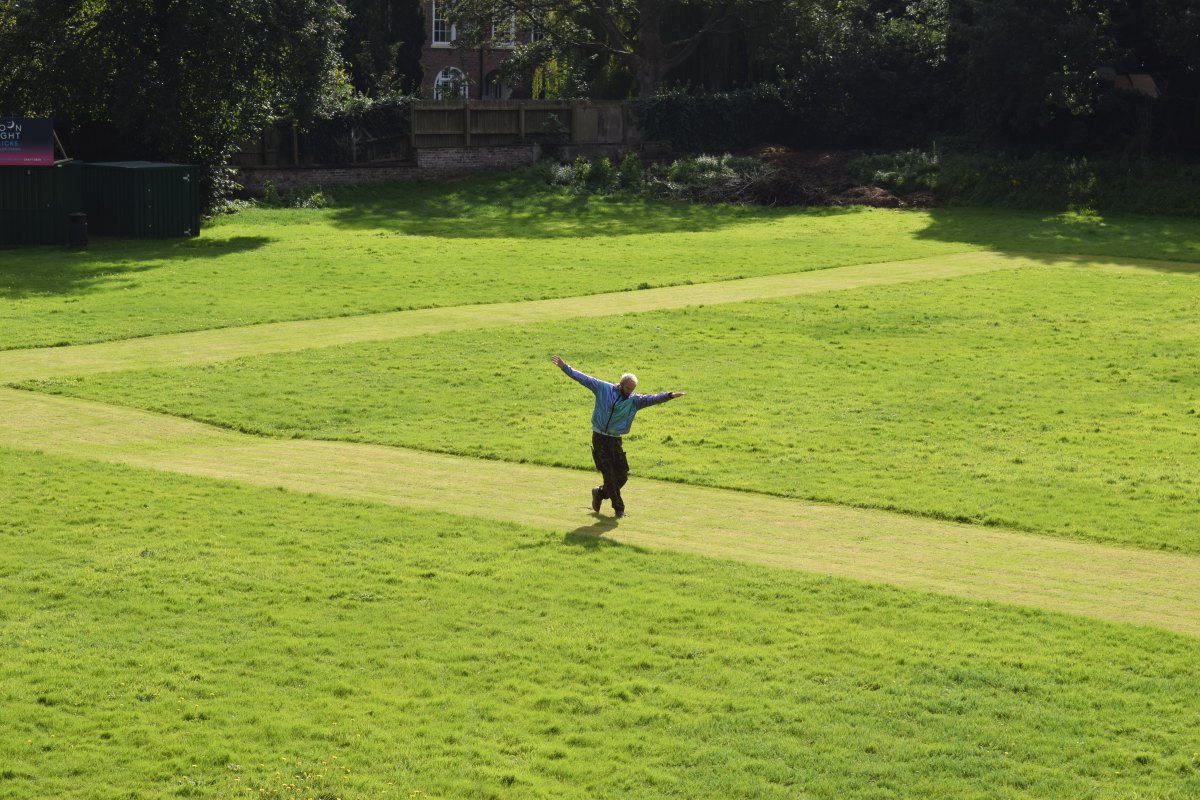
Also within the cathedral estate, on the Dean’s Field, was Crop by William Lang. Part of the Chester Contemporary Emerging Artists programme, the performance, structured with elements of improvisation, took place on and around a mown square representing the cathedral cloisters. The performance that took place condensed a day in the life of a medieval monk to just over twenty minutes, with elements showing waking, moving in and around the cloisters over the course of the day and finally retiring to the dormitory at the day’s end. A performance of Crop can be viewed on YouTube at https://www.youtube.com/watch?v=TiggsB3uDh8.

William Lang performing Crop, 23 September, 2023, viewed from the City Walls. Photo J Dixon

Two things stood out about this piece, both related to its relationship with its audience. The first was that, attending on the Chester Contemporary launch weekend, it was an incredible experience to be part of a large crowd standing together on the City Walls paying attention to something. Although most visitors to the walls, and local residents too, may occasionally pause to look at something or to take photos, engagement with the walls is usually in motion, so to make people stop and observe for a relatively long time offers a new way of engaging with heritage. Durational engagement is really important. People will always learn more about a place or space the longer they engage with it, and being still for a good amount of time is a very effective way to get to know a place or a building. The twenty or so minutes standing still on the wall by the Dean’s Field to observe a representation of a day in the life of a medieval monk combined two different durational experiences in an interesting way, slowing down experience of the city while speeding up a particular aspect of history. The effect was to unsettle more typical engagements with the past by letting people experience time passing. The result is heritage interpretation that people do not simply consume but of which they are part. Both on the day and subsequently, there have been comments on this piece on social media and made to the author directly from people who ‘had no idea what that was about’. Any response to art is fine, and this is a fairly typical response to contemporary performance from those who have not necessarily experienced work like it before, but it highlights both that occasionally more explicit prompting might be required to help an audience along in their understanding of the content of a piece and that, conversely, there is not always something to ‘get’, not a story that people are meant to follow and understand as in a play. So, while this piece took as its inspiration a day in the life of a medieval monk, the audience was not supposed to come away with a better understanding of that life but of the passage of time (the contrasting passages of time as discussed above), of the difference between their part in the event and the artist’s, and the experience of having stood still in a familiar place and watched an unfamiliar performance happen before them. The intricacies of movement, staging, the physicality of the performance might also be appreciated, all of which were not placed second to any story one was supposed to absorb and remember as they may be in other media. Ultimately, this was a fascinating piece and a type of artwork that could do a great deal to expand and change how we understand and experience the historic city.

Roodee

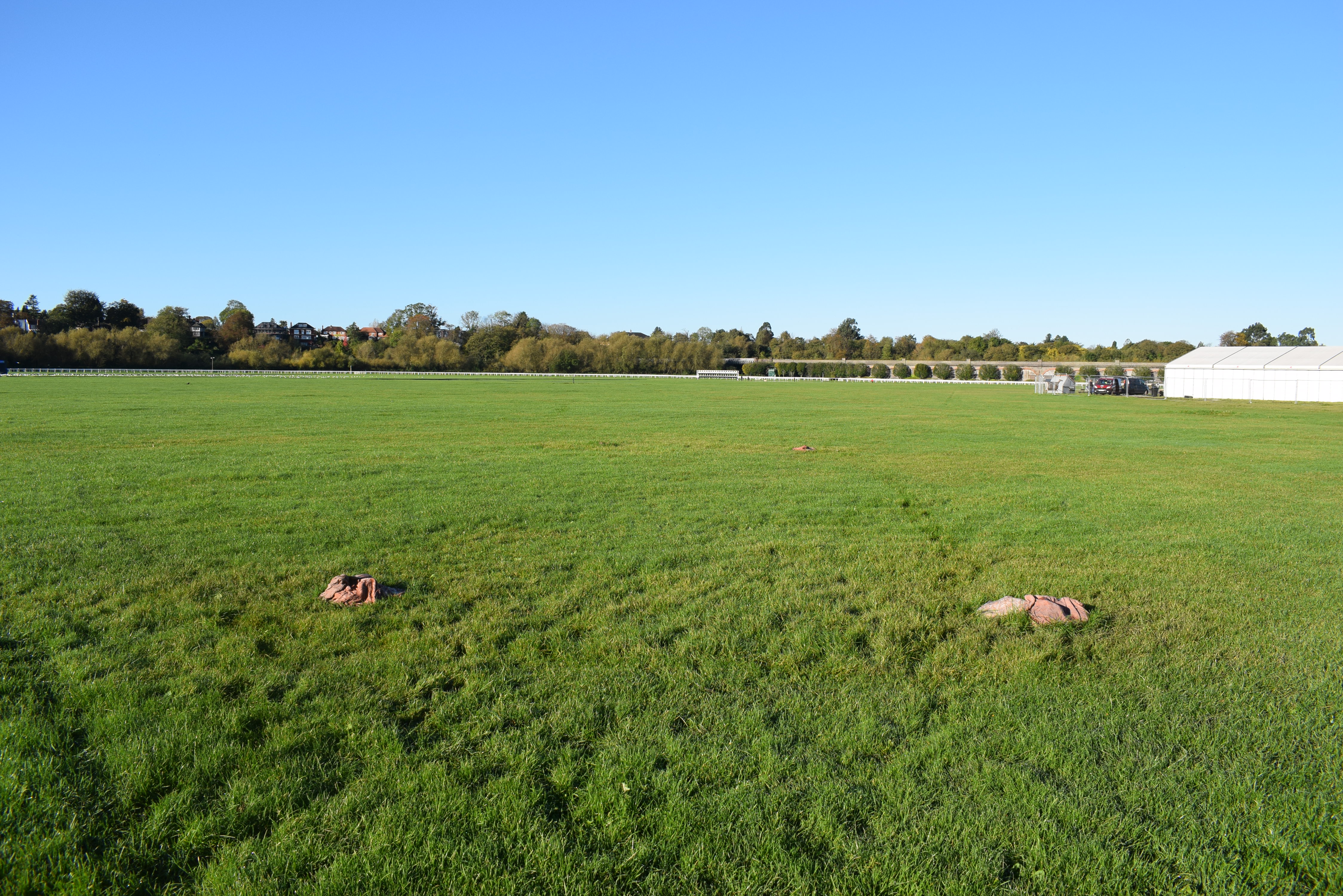
A Sweet Connection, Sorry Paul (Way After Goteddsday) by Nick Davies was located on the Roodee, inside the racetrack. The piece itself was formed of four ‘jumpers for goalposts’ made of casts of clothes and it referred to both the artist’s childhood and the historic football matches played on the Roodee on Shrove Tuesday.
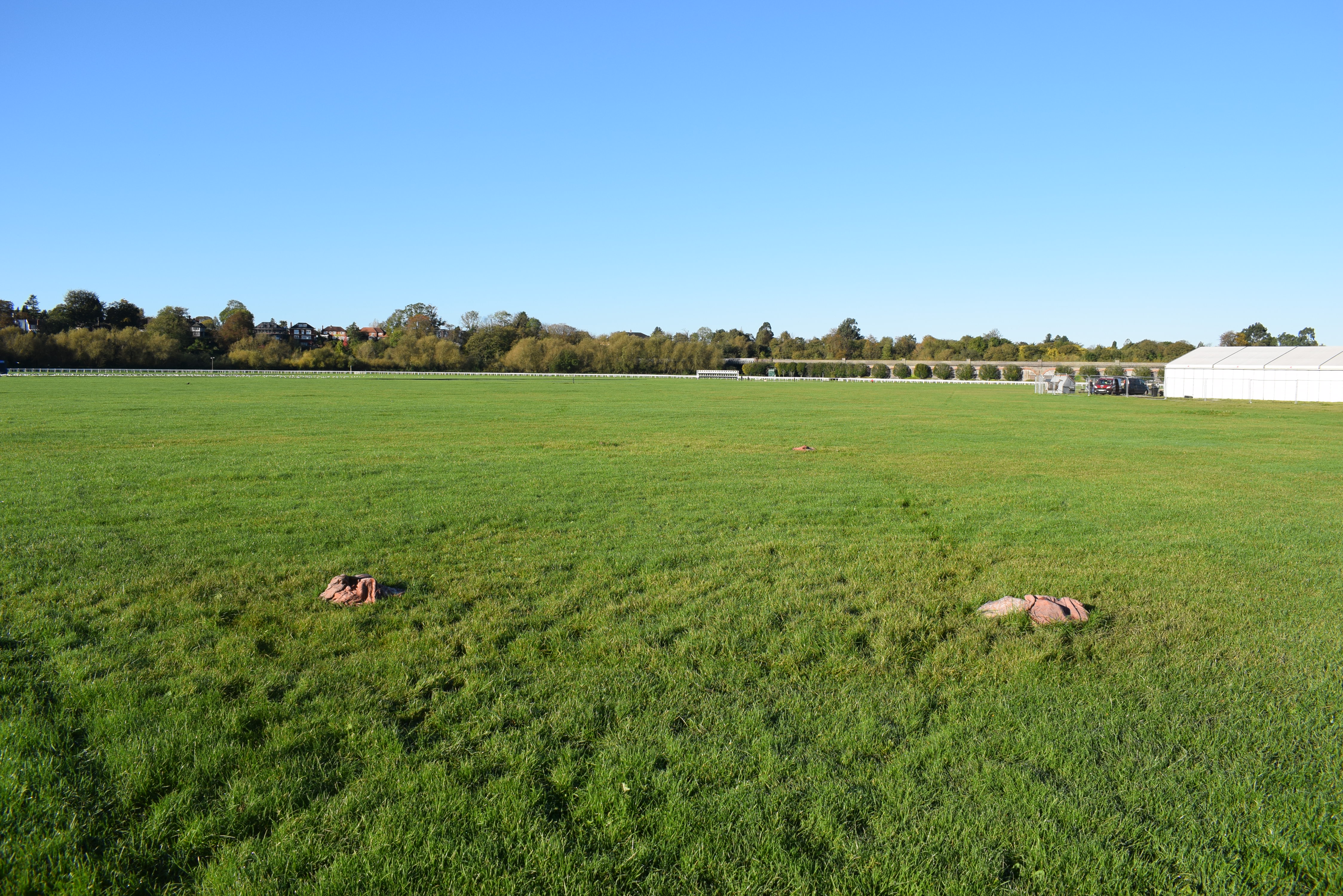
Nick Davies’ A Sweet Connection, Sorry Paul (Way After Goteddsday), Chester Racecourse. Photo J Dixon

This was, itself, a good piece of heritage interpretation, neatly placing present-day lives into the passage of longer periods of time, perhaps connecting forgotten historical traditions with how people remember, or do not remember, parts of their own lives. However, the work was something more than that when viewed in context in a way that could not perhaps have been foreseen by the artist. Because of heavy rain, towards the end of Chester Contemporary the Roodee was heavily waterlogged with large pools of water on its river side. Already this added a different dimension to the work, as another layer of history became visible. Not only was the work about the present day, the artist’s childhood and about the medieval city, but people could also see a hint of Roman and early medieval Chester in the same space as the former harbour started to reclaim the land. But, stepping back further, one could also observe that the temporary artwork and sodden Roodee were overlooked by formal heritage interpretation in the form of an information board and viewer on Nuns’ Road. The easy juxtaposition between formal and informal interpretation in one location, contrasting in form, but complementing each other’s content, made for a more rounded appreciation of the heritage of the location. However, it should be noted that the viewer is out of use, leaving the visitor to fill gaps in order to understand the site. Altogether this was a fascinating collection of different kinds of heritage interpretation that was enabled by the siting of Davies’ piece.

View over the Roodee showing formal heritage interpretation board with flooding in the background. Davies’ work sits in the centre ground, to the right of the Grade II* listed shaft of the Roodeye Cross. Photo J Dixon

The Nineties

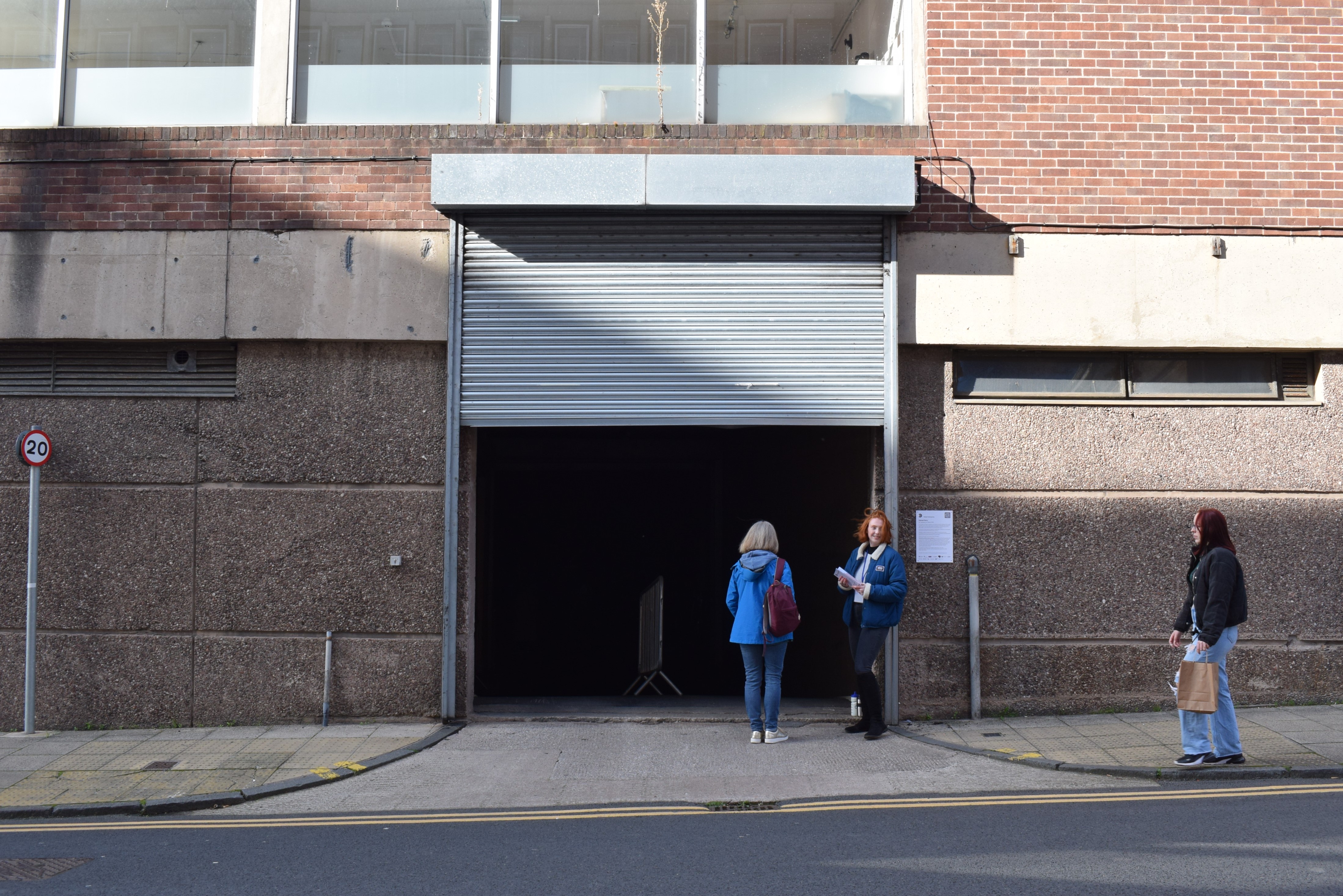
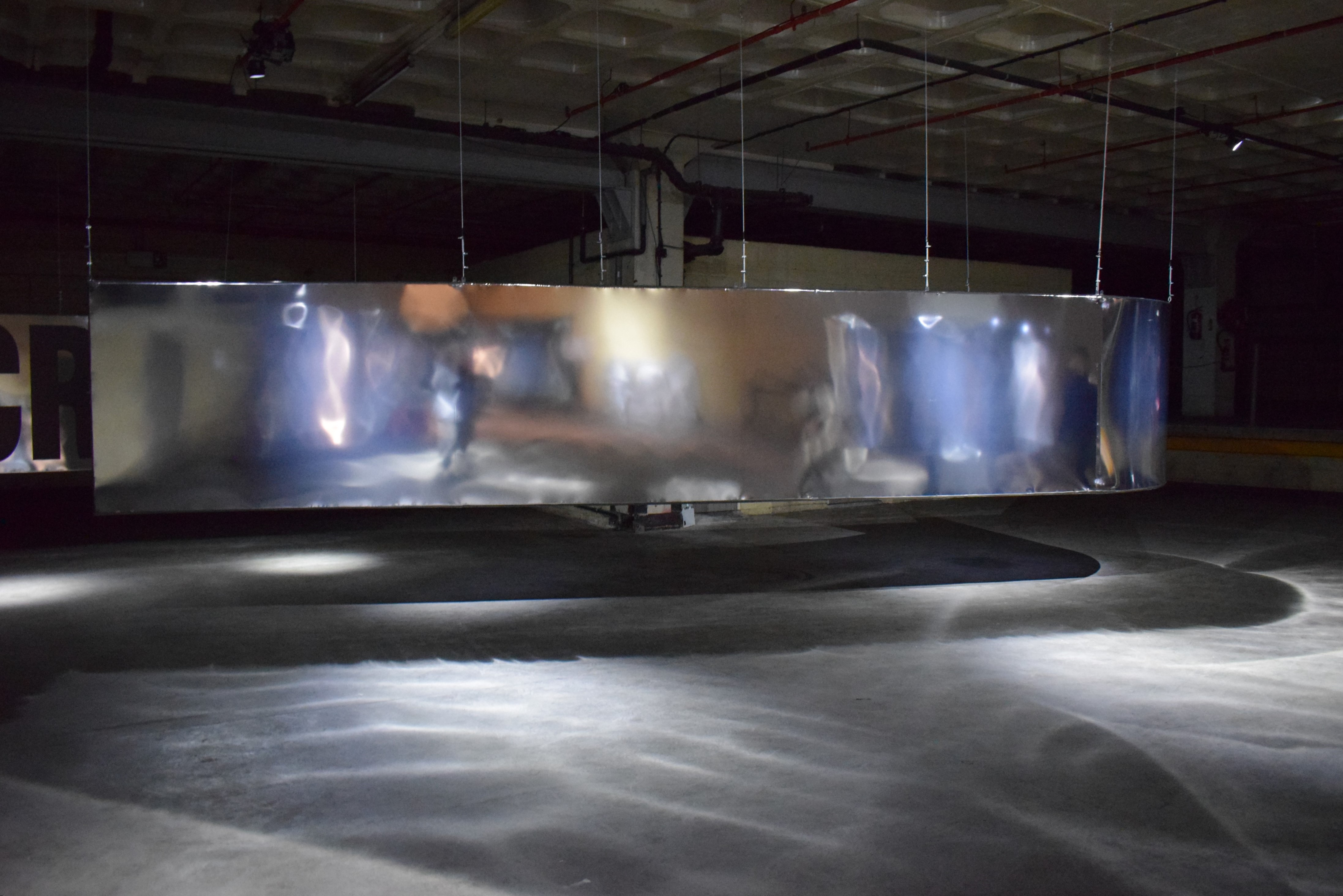
Works by Jacq Bebb and Hannah Perry were derived from experiences growing up in Chester in the 1990s, a period that might not ordinarily be thought of as falling under the remit of archaeology but which can be fruitfully investigated as well as any other period, with the added interest that most people remember it. Perry’s work No Tracksuits, No Trainers was installed in the old market depot off Hamilton Place and consisted of a number of metallic vinyl sheets hung in front of speakers on metal frames so that they vibrated when a soundtrack was played. The installation also included vacuum-formed car parts and clothing.

Part of No Tracksuits, No Trainers by Hannah Perry, former Chester Market depot. Photo J Dixon

No Tracksuits, No Trainers was a comment on being a working-class woman in the contemporary art world but took its inspiration from the door policy at nearby Rosie’s nightclub, the need to own the right clothes to be able to enter, the need to have a car to get anywhere in this part of the world, aspects of the culture surrounding cars and car modification, and the juxtaposition of car parts and the creativity of modification with Chester’s reputation as a heritage city. Viewed as heritage interpretation, Perry’s piece served to highlight aspects of life growing up in and around Chester that more comfortable or older residents, or residents who grew up elsewhere, might not be aware of. The focus on Rosie’s was particularly key as that nightclub a point of connection between Cestrians of a certain age, and many people under the age of thirty who visit Chester will have experience of Rosie’s as well. Thus it was possible to learn something about growing up in the area (and how its restrictions and barriers can be echoed later in life), but also to focus for a short time on a local place that is as important to some people as Browns, the old market or Owen Owen are to older reminiscers.

Also focusing on Chester clubs in the 1990s was Jacq Bebb’s sound installation Skulking The In-Betweens (Queer Time), a trio of recordings playing along the south side of Watergate Street at Row level. The spoken words making up the recordings were inspired by Bebb’s recollections of hanging around outside Connections, an LGBTQ+ nightclub on the street, being too young to go in but wanting to be part of the life that went on inside behind closed doors, and of what being able to go inside represented. Again, there was a focus on a forgotten part of Chester’s recent past as in Hannah Perry’s installation, but Bebb’s work looked at modes of investigation in a way that archaeologists and heritage practitioners can appreciate.

Bebb’s wider body of work often returns to the idea of ‘skulking’, going where the mood takes one, waiting around for something to happen, just being in spaces and places. This is a valuable form of archaeological investigation that all can easily try. Rather than relying on prior research, existing knowledge or guided tours, people can investigate places by simply being in them and waiting for things to draw their attention. There is an archaeological story to be told everywhere, and examining a particular space without preconceived notions of what it is or what one is looking for can take interpretation in interesting directions, where ‘the archaeology’ is more a collaboration between the viewer and the site than something he or she imposes on it as a knowledgeable interpreter or physically extracts as an excavator. Bebb’s focus on ‘skulking’, and their informal installation that could be heard in passing or by accident, also serves to democratise archaeology, removing hierarchies inherent in much of the discipline and its outputs. There are forms of useful and important archaeology that can be done by anyone at any time and Bebb’s skulking is a perfect example of that.

Simeon Barclay

The final piece discussed here is Them Over Road by Simeon Barclay, which consisted of three sets of three neon words in front of draped parachutes located in the window of Chester Roman Tours on Grosvenor Street, inside an empty unit on the Bridge Street Row west, and in the bottom of the car park of Crowne Plaza hotel, visible from St Michael’s Way. The words themselves present something of a challenge to the city; Bitter-Lost-Hero, Boys-Bruised-Aloof, Arrogant-Flacid-Pose.
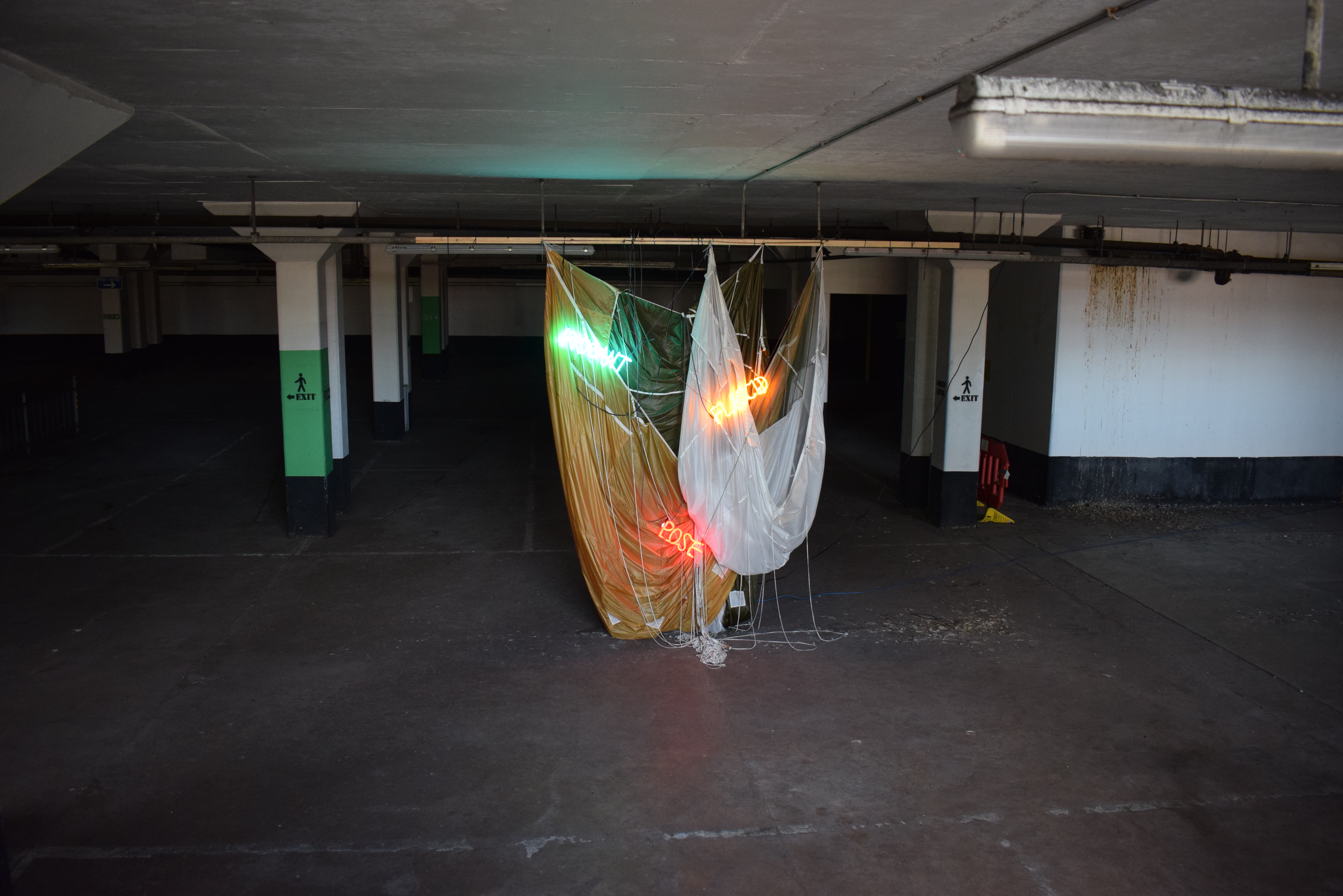
Part of Them Over Road by Simeon Barclay, Crowne Plaza Hotel car park. Photo J Dixon

These words are not the ones we might usually associate with Chester’s past or present and hint at a different story to be told. Barclay’s development of this work aimed to comment on the difference between the way Chester sees itself and the way it is seen, and the ways in which certain sites’ darker sides are written out of popular histories. The choices of Chester Roman Tours and the Rows, for instance, sought to highlight how we take certain aspects of our history for granted. The Rows, for instance, are not simply a benign heritage site in the present, but also a place where homeless people sleep and that has periods of trouble with anti-social behaviour. This is a side of The Rows that have been regularly reported on in local newspapers from their earliest editions but not one that is widely presented beyond Dark Heritage tours. Barclay’s point is that, even though we may seek to end those negative aspects of the Rows in the present and future, by ignoring those other presents and dark pasts we are ignoring a crucial aspect of the history of the Rows, which is that they are conducive to whatever has been deemed anti-social behaviour over at least the last two hundred years and possibly longer. Thus the Chester promoted through much heritage interpretation and marketing in the present day is at odds with crucial facts of its history. It is not to ignore the need to end anti-social behaviour in the present day to say that the Rows themselves enable bad behaviours through their intrinsic qualities of being central but separate, in places partially enclosed, a good vantage point and so on. Chester’s Roman history also has incredibly dark aspects that do not necessarily always make it into popular understanding of the period or the promotion of contemporary Chester as a Roman site. The City Walls, for instance, were intentionally reimagined as an attractive social space in the eighteenth century but were once a physical barrier separating different ethnic groups and political systems, one colonial-imperialist, the other more-or-less indigenous. The Crowne Plaza hotel car park has a more recent history, but is also at the centre of competing narratives, being dug out as part of an imagined future, but now little used.

With his multi-site work, Barclay used this historical commentary as a metaphor for the wider city and its view of itself, perhaps seeing an over-reliance on certain histories that are not the whole story and that have been sanitised. By extension, the work suggests that we need to recognise more of the complexities in Chester’s history and contemporary identity in order to have a strong future as something other than a tourist destination selling a particular view of the past. This was, perhaps, the Chester Contemporary artwork that spoke most directly to the complicated relationship between past and future manifested in the present.

Chester Contemporary and the Future

When Chester Contemporary was launched in 2022, curator Ryan Gander talked about wanting to create a new future for art in Chester. He spoke about there being nowhere for artists to meet each other and that artists who grow up here needed to move away to pursue their art. This is not just Gander’s vision. Chester Contemporary was itself part of a long-running effort by the Arts team of Cheshire West and Chester Council to transform the city’s art scene and strengthen its artistic community. The fact is that there are artists resident in Chester who say publicly that they work from Manchester because it has more kudos. Clearly, one thing that Chester Contemporary showed is not just that Chester can successfully host a walking biennial featuring internationally known artists as well as local talent, but that the works in something like Chester Contemporary can be of a key part of how we understand the city and its past. Chester Contemporary was an important archaeological event for precisely this reason. Not only did it occupy and change spaces we think that we know; it told new stories, told old stories in a different way, and afforded new ways of being in the city as archaeologists and heritage practitioners. Part of how Chester Contemporary changes the art scene in Chester can be how archaeologists and heritage practitioners engage with art and artists, how they take inspiration from the way artists engage with the historic environment and how they communicate with different publics. The future of art and archaeology/heritage in Chester can be seen as mutually dependent when it comes to innovation and developing new ways to look at the world and its pasts. As each develops and innovates, the other can respond. Ultimately, what Chester Contemporary demonstrates is that there are infinite possibilities when it comes to understanding and communicating history, archaeology and the historic environment, and hopefully this will become widely recognised and practiced as Chester’s contemporary art scene grows and is strengthened.

Acknowledgements

I should like to thank Simeon Barclay, Jacq Bebb, Hannah Perry, Nick Davies, Carmel Clapson and Emma Knight for discussions about artistic and archaeological practice, both during and since Chester Contemporary.

Chester Contemporary was funded by HM Government (UK Shared Prosperity Fund), Arts Council England, National Lottery Heritage Fund, Henry Moore Foundation, Historic England and National Lottery Heritage Fund. Project partners included University of Chester, Storyhouse, Open Eye Gallery and Edsential.

Categories
Art-Archaeology

The Archaeology of Chester Contemporary

Part of a talk given at the Grosvenor Museum, Chester, on 11 November 2023 as part of the Chester Contemporary events programme.

Introduction

As archaeologists, we move from the known to the unknown. We start with a thing and work to understand it for itself. Then we widen our gaze and add that thing to other things to try, eventually, to create new knowledge about complex past worlds. Archaeology, the way we understand both the things and the complex worlds, takes many forms. It is the trenches, the trowels, the measuring tapes, the theodolites, the laser scanners, the magnetometers, the isotope analysis, the papers, the journals, the conferences, the lectures, the books, and the television shows. But as well as those things that archaeologists make and use, archaeology is also in us. The difference between two soils, invisible to the eye, but felt and understood in our bodies, transmitted by the extension of the arm via a trowel, into an act of scraping. It’s there in the feelings and hunches, the choice to look one way and not another, the decision to communicate, how, when, and with whom. Those archaeologies that happen within us are all-important because, of course, not only does all archaeology happen today, in the moment, but all of the past and all of the future exist in the present too. So when we are doing those existential archaeologies of looking and feeling, what we are doing is simply being in proximity to all time, and trying, if we choose, to make sense of that, and maybe even do some good with it.

The works of Chester Contemporary are archaeology. They are archaeology in that they are things we can look at, feel, and attempt to understand. They are also, separately and together, a tool for us to understand Chester’s past and future; not facts about the past, not stories from the past, not specific hopes or predictions for the future, but how multiple pasts and futures exist all around us today. It’s vital that we take these chances to understand that because pasts and futures are neither fixed nor passive. They are fighting for attention, sometimes by themselves. Our knowledge of the past, for instance, is largely directed by those things that persisted, and refused to decay. So when I tell you that Chester Contemporary is one of the most important archaeological events in Chester’s history, you shouldn’t be surprised.

Chester Contemporary has complicated the way the past exists in contemporary Chester and artists and archaeologists all, we can gain a lot from putting ourselves into the middle of Chester Contemporary and the things and experiences it has created, and use that to understand what it is to be a person in this historic place. You may wish to use that understanding to simplify things. My preference, as it has always been through, now, multiple decades as an archaeologist, has been to use archaeological knowledge to try to come to terms with standing on the edge of an abyss containing all of the past, all of the present, all of the future; three things we can barely make out, let alone understand. Fleeting glimpses from the edge of everything is all we have.

Nature & Geology

Sometimes we need to pull back from the edge of that chaos and order things just a little, so I want to talk about some particular artworks and their archaeologies. By coincidence, they fit chronologically, from the ‘oldest’ (for the sake of brevity today, I will stick to linear time) to the youngest, but they also work as scales, from grand and worldly to minute and personal.

Harry Grundy, The Mingling Tree (2023). Photo by James Dixon.

So we will first stand and appreciate Harry Grundy’s The Mingling Tree, a potted olive tree travelling around the miniature railway in Grosvenor Park, in places brushing leaves with its soon-to-be neighbours. As with many of the Chester Contemporary works, there is a great beauty to this act. Trees are Chester’s oldest living inhabitants, some of them living a wild life of random seeding, pollinated by wind and insects. Most of the trees in Grosvenor Park came to be with notably less agency, but still, this is a place of nature in the city centre, dominated by the kinds of things that were here before Chester. To welcome a new tree, to introduce it to its fellows, to draw attention to it and its, we may say person-like, needs in this way, is a very beautiful thing to do. It reminds us that in and around the Chester of people, there is an equally complex Chester of non-people that know each other, live with and for each other, who have bonds that will be in place when everyone in this room is long gone. Grundy’s tree will outlive us all, and it will carry into the future the memories of having once been at the intersection of human and non-human worlds, of the brevity of a journey around the miniature railway, and scales of time in which people and their cities are but a moment.

Performance of HORSETAILS by Elizabeth Price, Chester Cathedral, 24 September 2023. Photo by James Dixon.

Elizabeth Price’s HORSETAILS takes on these temporal scales, taking as its subject geology and its meeting with humans at the point of mining and extraction. To date, this work has been performed in three forms with a full choral working still to come. Chester Cathedral is a perfect setting for the work because inside there, you are surrounded by geology, most of which has been extracted, shaped and reformed into arches, columns and walls, even representations of people, but some of which is undergoing a process of creation as people buried below the cathedral floors slowly return to the earth.

Performance of HORSETAILS by Elizabeth Price, Chester Cathedral, 5 November 2023. Photo by James Dixon.

We are surrounded there by the geology at the centre of Price’s work, but that geology is active, being pulled and pushed by physical forces, yet arranged in such a way as to largely deny them. Sitting listening to Horsetails took me back 18 months to being in the cathedral watching the film Once A Desert by Heinrich & Palmer, a film which also spoke to the deep time origins of the building materials surrounding us, in this case 200 million years back to the Triassic. Once A Desert made much use of a wireframe scan of the cathedral building and at one point we, the audience, are taken shooting up the inside of one of the cathedral’s columns. This is, obviously, not a real viewpoint, but it is a real place, inside geology, inside structure from the point of view of physics, soaring skywards to challenge gravity. Price’s own work takes us on a similar journey, speaking the names of places and stones, words and music bouncing off the very geology it references to help us experience the piece, and through the piece, the place.

Undercurrents

Layers, and the interfaces between layers, are incredibly important in archaeology and they feature strongly in Chester Contemporary too. Works by Simeon Barclay, James Lomax and Nick Davies speak to ‘what lies beneath’, to those temporal undercurrents which occasionally expose themselves to today.

James Lomax, Markets Shift Like Sand V (2023), Bridge St, Chester. Photo by James Dixon.

Lomax’s placing of striped tarpaulins brings memories of Chester’s historic markets into the present city, a space of uninterrupted commerce since the medieval period. The tarpaulins, ostensibly randomly placed do not just refer to that past, but remind us of the trajectory of that history. Closed shops may be distressing to the City and its people for months, years, but within a thousand year history, those shorter times are as nothing. Lomax’s tarpaulins tell us that things will be ok.

James Lomax, Markets Shift Like Sand V (2023), Eastgate St, Chester. Photo by James Dixon.

As we face uncertain futures, we, as people and as a city, are willed on by hundreds of thousands of traders across time, with whom we share our streets. Lomax’s Markets Shift Like Sand V has them peeping through windows, watching us as we walk, shop, hurry and worry.

Nick Davies, A Sweet Connection, Sorry Paul (Way After Gottetsday) (2023), Chester Racecourse. Photo by James Dixon.

Nick Davies work A Sweet Connection, Sorry Paul (Way After Gottetsday) references the artist’s own childhood, but is placed to also remind us of a forgotten piece of Chester’s history, the Shrove Tuesday football match that took place on the Roodee, though its referencing of a punch by the artist also brings to mind the so called ‘pitched battle’ fought here in 1441 between Rokley and Hooley, the gaolers of the Castle and the Northgate, the county and the city. A place of sport then, and a place of violence, and a place of violent sport. It is not only history that lies beneath, but other things too, violence being one of those undercurrents most likely to burst through to the surface.

But there are other dark undercurrents too and Simeon Barclay’s Them Over Road tackles them head on. Them Over Road is in three locations, in each of which neon words hang enmeshed with parachute fabric and cords. Those words are Bitter, Lost, Hero, Boys, Bruised, Aloof, Arrogant, Flacid, Pose.

Simeon Barclay, Them Over Road (2023), Crowne Plaza car park, Chester. Photo by James Dixon.

Of all of the Chester Contemporary works, Barclays is, to me, the darkest, the most menacing. In part, this is because of its locations, the basement car park, the empty shop, places where we have to work to find the piece and see it properly. But it’s also menacing because of the message of the work, that Chester’s focus on heritage is at odds with its aspirations and the ways in which a diverse range of people use and live in it, with which we may disagree. And that’s uncomfortable. It’s a view of Chester from the outside that isn’t really found across the rest of the Contemporary, but which, having found it, as archaeologists we cannot ignore.

Chester Contemporary, whether we see it as an archaeological section, a literary palimpsest or a geological melange, takes times other than now, past and future, and reveals to us how they exist in the present day, as legacy, memory, reference, hope and fear.

The 90s

Auto-archaeology is the archaeology of oneself, or explicitly of ourselves. I regularly walk through the streets of Chester listening on the Spotify app on my phone via wireless earphones, to the same music I bought in those streets on CD in the 1990s, and walked around listening to on my Discman. The archaeology of the 1990s is there in me every time I walk through town, but it’s also there in the works of Hannah Perry and Jacq Bebb, who both grew up walking through Chester at more or less the same time I did.

Entrance to Hannah Perry, No Tracksuit, No Trainers at The Old Chester Market Delivery Depot, Chester. Photo by James Dixon.

Perry’s No Tracksuit, No Trainers is a comment on being a working class woman in the contemporary art world, but it’s also a memory of growing up in Chester and having to meet the sartorial requirements of the bouncers outside Rosies. It’s also about the act of remembering.

Hannah Perry, No Tracksuit, No Trainers (2023). Photo by James Dixon.

Stand in front of one of Perry’s silver sheets and you will see a blurry reflection of yourself looking back. The soundscape begins with a low rumble, causing your reflection to pulse and shake, and as the vibration builds, you see yourself and your world transformed. To be here, there, today, on one day within a life, within a whole history of place, and to be confronted by the conflict between certainty and confusion, the latter exacerbated by Perry’s sensory experience, is to get to the heart of your own Chester, and of art as archaeology. No Tracksuit, No Trainers takes you out of time, and after seeing it for the first time, you emerge from that underground depot into a different Chester to the one you left. The nightclub experience Perry references is the one point in common I have with Cestrians anywhere in the world. When we meet, and speak, Rosies is where we begin. As archaeologists, we work from the known to the unknown. We stand at the door of a nightclub, with the countless others who have been and are still to come, and from it we understand our world.

Jacq Bebb in conversation with Jeremy Turner, Watergate Row South, Chester, 23 September 2023. Photo by James Dixon.

Jacq Bebb’s artistic practice, which they call ‘skulking the in-betweens’, parallels my archaeological practice of walking, looking and feeling, putting myself into places both known and unfamiliar, to see what stories they want me to communicate to others. Bebb’s Queer Time, a sound installation which takes as its inspiration 1990s memories of hanging around not getting into a nightclub on Watergate Street, changes your experience of that street. When we are going from shop to shop, from home to work, from a to b, or from the known to the unknown, the going doesn’t have to just be a means to an end. It has its own experiences, its own meanings, its own value. I first heard Bebb’s sound work with Jacq Bebb, having arranged to meet there. And the second, third, fourth times, I watched the clock and went intentionally to hear it. But then I heard it by accident, killing time in the city centre waiting for an event to start, I wandered along Watergate Street only to hear Queer Time playing up on the Row. I hadn’t expected it. I had, for that moment, forgotten it. And to have that aimless moment interrupted by Bebb’s work, their memories… well, I laughed out loud. Bebb’s work comes from skulking, and it’s best heard mid-skulk. It’s a reminder that you don’t have to get where you think you’re going to have a story to tell.

Conclusion

So… Chester Contemporary is archaeology and not only that, it’s a key part of how we understand Chester’s pasts as they exist today. The ways it does that are not, perhaps unique. We don’t need artworks to trigger memories, or describe our surroundings. We don’t need artworks to make us feel. We don’t need artworks to create juxtapositions, expose undercurrents, or question what we think we know. But artworks are great at doing those things because the way we experience those things in relation to artworks is usually unexpected. So we are not just dealing here with archaeology, we are dealing with great archaeology, archaeology that reaches inside us and rearranges our very being. It’s important too that all of this art-archaeology is happening at the same time. For the duration of Chester Contemporary, whether you experience it for two months or for a day, that feeling of delving, scraping, thinking new things and feeling things you didn’t expect to feel is made overt, and it’s not just you feeling these things as you notice something odd on your way to work, it’s all of us together noticing things at the same time. So it’s not just great archaeology, it’s great community archaeology too.

Crowd listening to Jacq Bebb, Watergate Row South, Chester, 23 September 2023. Photo by James Dixon.

We are not finished here today. There is more to be said. But when you leave here, I suggest you walk the Contemporary again, but think about the spaces between those artworks as well as the pieces themselves. Find other bits of Chester that tell the same stories as Jacq Bebb and Hannah Perry. Find other bits of Chester that unsettle you as much as Simeon Barclay. Find weird spaces and imagine what new things you would put in them. Then, you will be my kind of archaeologist, looking at your own worlds and your own lives in ways that might just astonish you.

Chester Contemporary is not just a thing that happened. It is contemporary Chester. We can all be contemporary archaeologists and as contemporary archaeologists we can take those knowns, our memories, favourite places, buildings and artworks, and work from them to an infinite unknown universe, all here in our little city. And that’s exciting.

Email jamesdixonresearch@yahoo.co.uk for more information.

Categories
Uncategorized

Unarchaeological archaeologies at HouseRules – BOUNDING, UNDERSTANDING, REPRESENTING

I wasn’t going to post this, but someone who took part and who I saw last weekend for the first time since told me they thought it was interesting so I might as well! Details about HouseRules are here. The works constitute an alternative archaeological record of the Eastway underpass in the Olympic Park,made as part of HouseRules back in May.

DSC_0012

1 Bounding

I tried to describe the site rather than just drawing a line on a map and did not edit:

EAST

The most solid edge of the site is formed by a barrier of large panels, concrete tongue and groove, holding back the bank of the Eastway while holding up the Eastway itself. The barrier spreads, perhaps, beyond the site, or is the site, the boundary, the limit. Deceptively linear, the surface of this edge rises and falls with the interface of each pair of panels while where concrete has decayed or been intentionally broken we see further texture. A hierarchy, stratigraphy, of paint schemes places micro-layers over the boundary edge, but all are within the site as below, between giant letters, we see through to the pebble matrix of the original concrete. The real edge? The beyond? The exception that proves the ruler, a hole in almost the furthest panel north at the edge of the concrete road above takes us 30 cm further to a curved, moist, metal edge. Beyond the moisture, everything else. The whole emits a cool breeze. We must call this edge indeterminate. Oh, but above the panels, below the road, steel grilles and a void behind. No idea what’s behind there, it’s too high to see, wrong angle, but there’s something further for sure. At least now we…know…that…we…don’t…know, as they say, or keep saying. We must call this edge indeterminate.

DSC_0045.JPG east small

NORTH

Can’t see the north boundary of the site so we have to infer. Marks on the floor of a former wall base in the north-east. That’ll do (but less ambivalent). This edge then formerly hard, in part, now not. Characterised by, if anything, seepage of the outside in or the failure of the inside to be so. Bicycle track in mud a main entry point, a thin strip of access between the inaccessible and the wrong way. Up the whole line, concrete flags run into soil, debris, fallen leaves (a year-round feature). Beyond, well, not site, but it’s dirtier, things dumped beyond the boundary maybe, or pushed there. As for the world, so for this underpass. Tree roots break the line, of course, and occasionally branches of the trees themselves. The other corner we cannot discern. The boundary line is obscured by, or becomes, or is a pile of reclaimed wood waiting for use. It belongs to the man who owns one of the boats. The line runs from a scrape of past to a pile of future. How…cheesy of it. We must call this edge indeterminate, but it has the novelty of performing four dimensions. That’s something.

DSC_0050.JPG north small

SOUTH

We’ll call this metal fence the southern boundary. It seems to hold out, or in, very little. Gravel, spider webs, dead leaves, rubbish, weeds, all exist on both sides, but then they’re small and the fence is much more hole than fence. Bikes are only ever on our side, and we have way more copies of Time magazine. We’ve got loads of copies of Time magazine. Big plants are only on the other side, but they lean in. The fence turns a corner and carries on, fencing its merry way somewhere else, around the plants I suppose. This boundary is not indeterminate, although, although, climbing plants growing from beyond it have twisted around the spikes of the fence in the south-west corner. But they can’t all be indeterminate.

DSC_0041.JPG south small

WEST

Western boundary, water boundary, western water boundary is predominantly made of air. For the most part we can discern the line between which molecules are ours and which are not by the not-straight line on the floor between our site and a double row of cobbles that I generously assign to the rest of the world. The line is occasionally broken. Poured concrete doesn’t care. There used to be a wall here of some kind but now only the base remains. The air hasn’t moved.

DSC_0060.JPG west small

UP

Up is infinity and the Eastway. There are small holes between structural elements, but it is by and large solid, although in two parts, lanes, divided by a big gap of nothing much, today sunlight. People have been there and tested it, either personally or via their agents. Most of the concrete-encased beams of the structure bear the marks of muddy footballs and occasionally there is chalked writing. People have tested this boundary and found it hard, despite the massive hole.

DSC_0058.JPG up small

DOWN

The bottom, the floor, base is the most indeterminate of all. There are concrete flags and poured concrete, sure, and tile and it’s holding us up and we can’t see through it. But, first but, there are drains, drains that go where we don’t know. And that’s excitingly indeterminate because although we don’t now where they go, we know that they go somewhere. But also, the biggest but, bigger but, there are also fucking ants’ nests. The limits of our site are only known to fucking ants. I can’t top that.

DSC_0039.JPG down small

2 Understanding

An alternative to putting a grid through the site, I reduced it to its spaces.

DSC_0190

3 Representing

I created a temporary, ephemeral archive of the site on my body.

DSC_0069.JPG small

DSC_0080.JPG crop small

DSC_0075.JPG small

Categories
Uncategorized

Coming Soon – People Tend To Sit Where There Are Places To Sit – 27/09/2013

After starting the month speaking at The Parlour Showrooms in Bristol on tools and people in the city, I’ll be ending the month with another public event, this time in Cricklewood in north-west London. This discussion event will be taking place next to a piece of waste ground in Cricklewood as part of a month of events by Spacemakers investigating the lack of public space in the area, based around the idea of a Cricklewood Town Square. More info here.

Cricklewood

The discussion will aim to be quite practical, and focus on how people can get or create public space for real and I’ll be speaking alongside Sarah Goventa from CABE and Finn Williams, a planner from Croydon Council among others to be confirmed. I’ll be using my research in archaeology and public art to look at how public and private spaces come to exist, how they change status and identity, why that makes people angry and how that anger can be used as a creative force.

See you there?